Commercial Vehicles
China’s Electric Truck Market Is Moving Faster Than Many People Realize
China sold more than 400,000 electric trucks in 2025. Short routes, battery swapping and industrial economics are making heavy-duty electrification practical.
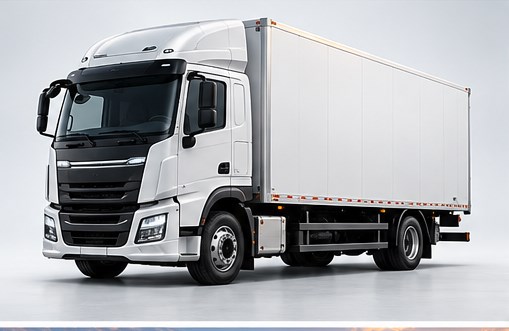
.jpg)
Image: BYD E-Vali IAA Transportation 2024 (DSC04019).jpg, Wikimedia Commons contributor. Check file page; Commons license.
.jpg)
Passenger cars dominate EV headlines, but China’s electric-truck market may be more consequential for energy use and industrial emissions. Heavy trucks travel long distances, consume large amounts of fuel and often operate in fleets where cost can be measured precisely.
In 2025, more than 400,000 electric medium- and heavy-duty trucks were sold in China, according to the International Energy Agency. China accounted for more than 90% of global electric-truck sales, and one in four trucks sold in the country was electric.
Heavy-freight adoption accelerated sharply
Electric heavy-freight trucks reached a 28% sales share in China in 2025, up from 13% a year earlier. That is unusually fast for a segment once considered difficult to electrify.
The key is that many trucks do not need to solve every long-haul use case. Vehicles serving ports, mines, steel plants and construction sites may run predictable routes and return repeatedly to the same depots.
Predictability makes infrastructure easier to build.
Total cost of ownership matters more than sticker price
A fleet operator cares about purchase price, energy, maintenance, financing, downtime and residual value. Electric trucks are usually more expensive upfront, but electricity can be cheaper than diesel per kilometer and electric drivetrains have fewer high-maintenance mechanical parts.
The IEA has found that battery-electric heavy trucks in China can reach total-cost-of-ownership parity with diesel in certain use cases over a five-year period. Policy support and scrappage incentives can shorten that payback further.
Battery swapping solves the downtime problem
Truck batteries are large. Even a very powerful charger may need substantial time to add hundreds of kilowatt-hours. China has therefore developed swap-capable heavy trucks.
The IEA says battery-swap trucks accounted for around 15% of China’s electric-truck sales in 2025. A fleet can exchange a depleted pack at a station and return the truck to service quickly while the removed battery charges separately.
The model works best on repeated routes where a small number of stations can serve many vehicles.
Depot charging remains important
Swapping is not the only solution. Trucks that sit for hours overnight can use depot charging, which is simpler and may use cheaper electricity. Route planning can combine overnight charging with high-power top-ups during breaks.
The optimal strategy depends on daily distance, payload, shift schedule and local grid capacity.
Industrial use creates environmental leverage
Ports, mines and steel plants often have concentrated truck activity and significant local air-pollution concerns. Electrifying those fleets can reduce tailpipe emissions in areas with heavy diesel traffic.
It can also help industrial companies meet carbon targets, especially when electricity comes increasingly from low-carbon generation.
The grid challenge is substantial
A depot with dozens of heavy trucks can require megawatts of power. Infrastructure planning therefore needs to start early. Utilities may need to upgrade transformers and local distribution networks.
Smart charging can reduce peak load by staggering sessions. Stationary batteries can also buffer the grid, although they add cost and conversion losses.
Export opportunities and obstacles
Chinese truck makers can export vehicle technology, batteries and swap systems, but economics differ by country. Diesel prices, electricity tariffs, road tolls, payload rules and financing determine whether an electric truck is competitive.
Weight limits are especially important. A large battery can reduce payload if regulations do not provide an allowance for zero-emission trucks.
Service is another challenge. Commercial vehicles cannot wait weeks for a replacement inverter or battery component. Importers need local parts, diagnostic tools and technicians before deploying a fleet.
A practical fleet-evaluation framework
Before buying an electric truck, model the route rather than the brochure:
| Input | Why it matters |
|---|---|
| Daily kilometers | Determines energy requirement |
| Payload and terrain | Changes consumption significantly |
| Dwell time | Determines charging opportunity |
| Electricity tariff | Drives operating-cost advantage |
| Diesel price | Sets the comparison baseline |
| Grid connection | Can be the limiting infrastructure factor |
| Battery warranty | Critical for high-mileage operations |
China’s truck market is important because it shows that heavy-duty electrification does not have to wait for a perfect universal charging network. It can start with high-utilization routes where infrastructure and economics can be tightly controlled.
Why truck electrification can scale by corridor
Passenger-car charging networks need broad geographic coverage because private drivers travel unpredictably. Commercial fleets can electrify one route at a time. A port-to-warehouse corridor may need only a few reliable high-power sites or swap stations.
That allows infrastructure investment to follow known utilization. A charging site serving dozens of trucks every day can justify expensive grid upgrades more easily than a public station waiting for occasional users.
Battery degradation also needs different assumptions. A truck may cycle its battery deeply almost every day. Fleet contracts should specify usable-energy retention, throughput limits and what happens when the battery no longer supports the required route.
FAQ
Why is China so far ahead in electric trucks? High sales volume, falling battery costs, industrial decarbonization pressure and targeted incentives have aligned with suitable short-route use cases.
Are all electric trucks long-haul capable? No. Much of the current success is in predictable regional and industrial operations.
Why use battery swapping? It can reduce vehicle downtime when a very large battery would otherwise require a long charging stop.
What is the main infrastructure constraint? Grid connection capacity at depots and high-utilization charging sites can be more limiting than the charger hardware itself.
A final practical point: electric-truck economics should be recalculated whenever electricity tariffs, payload rules or route lengths change. Small operational differences can materially alter payback periods.