Industry
China’s Vehicle Export Boom: What the 2025–2026 Data Actually Shows
China’s car exports are rising quickly, but shipments, overseas sales and local production tell different stories. Here is how to read the numbers.
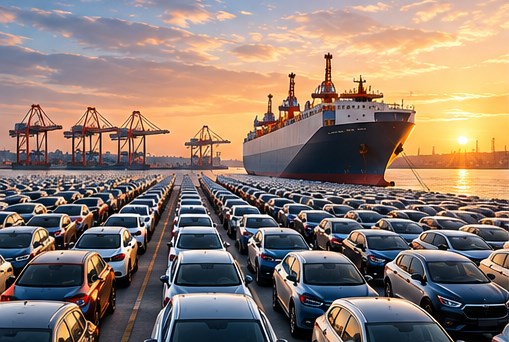
China’s rise as a vehicle exporter is now one of the biggest structural changes in the global auto industry. The headline numbers are large, but they can be misunderstood if exports are treated as the same thing as retail sales.
The International Energy Agency estimates that China produced about 16 million electric cars in 2025 and exported more than 2.5 million of them. Electric vehicles became the main source of growth in China’s car exports, while exports of conventional cars were roughly stable compared with 2024. In the first half of 2026, China’s total car exports rose around 65% year over year and electric-car exports increased more than 120%.
Export shipments are not retail registrations
An exported vehicle has crossed a border. It has not necessarily been registered by a customer. Vehicles can sit in ports, distributor compounds or dealer inventory for weeks or months. For fast-growing markets, that distinction can be substantial.
IEA analysis estimates that Chinese electric-car exports in 2025 exceeded overseas sales by more than 25%. The gap does not mean the exports are fictitious; it means inventory was accumulating outside China faster than final sales. When evaluating a brand or destination market, registrations and dealer inventory provide a better measure of consumer demand than customs shipments alone.
Why exports accelerated
Several forces are operating at the same time. China has enormous vehicle-production capacity, a very competitive home market and falling battery costs. When domestic demand weakens, producers have an incentive to search for overseas volume. The first half of 2026 illustrated this clearly: the IEA reported a sharp drop in China’s domestic car sales while exports expanded rapidly enough to soften the effect on factory output.
There is also a product factor. Chinese manufacturers now offer competitive small EVs, SUVs, plug-in hybrids, range-extended SUVs, vans and increasingly commercial vehicles. That makes it possible to address markets with very different income levels and charging conditions.
Europe remains important, but it is no longer the whole story
Europe receives a large volume of Chinese-made vehicles. ACEA reports that the EU imported more than one million Chinese-made cars in 2025 and that 42.9% were battery electric. Chinese-made cars represented 7% of total EU car sales and 20% of EU battery-electric car sales that year.
However, tariffs have changed the economics of direct BEV exports. The European Union introduced additional countervailing duties on battery-electric vehicles from China, with company-specific rates. As a result, manufacturers have greater incentives to sell plug-in hybrids not covered in the same way, localize production, pursue price undertakings or focus on other markets.
Emerging markets are becoming more important
The IEA says imports from China accounted for 55% of electric-car sales in 2025 in countries outside Europe and the United States. In Southeast Asia, more than half of electric cars sold in 2025 were from Chinese brands. Brazil, Mexico and other markets have also become significant destinations.
This expansion is not only about shipping finished cars. Chinese automakers are investing in assembly and manufacturing outside China. Local plants can reduce tariffs, improve logistics, meet local-content requirements and make after-sales support easier. Over time, the phrase “Chinese car” will increasingly describe ownership, engineering or supply-chain origin rather than simply the location where final assembly takes place.
The mix of vehicles is changing
A few years ago, discussions about China’s exports often focused on low-cost internal-combustion vehicles shipped to emerging markets. The mix is now broader. Battery-electric vehicles, plug-in hybrids and range-extended vehicles are increasingly important. China is also a major producer of electric buses, vans and trucks.
For importers, that means the opportunity is larger but the due-diligence burden is higher. Homologation, software language support, charging standards, spare parts, cybersecurity compliance, warranty reserves and battery-service capability matter at least as much as the purchase price.
Five numbers to track
A useful export dashboard should separate five metrics:
| Metric | What it tells you |
|---|---|
| Customs exports | Factory-to-overseas shipment volume |
| Overseas registrations | Actual end-customer demand |
| Dealer inventory | Whether shipments are outrunning sales |
| Local production | How much growth is moving outside China |
| Vehicle mix | BEV, PHEV, EREV and ICE exposure |
No single number gives the full picture. A market can show record imports while retail demand slows, or registrations can rise even as direct imports fall because local production is ramping up.
The broader implication
China’s export surge is not simply a temporary outlet for excess factory capacity. It reflects a maturing vehicle industry with competitive electric drivetrains, supply-chain scale and a growing ability to sell across multiple price bands. Yet the next phase will be more difficult than simply increasing shipments. Brands will need durable dealer networks, financing, parts supply, localization and regulatory compliance.
For analysts, the key is to move beyond the headline “China exported X million cars.” The more meaningful story is where those cars are actually sold, which powertrains are gaining share, how much production moves abroad and whether overseas operations become profitable over a full vehicle cycle.
What the export data does not tell you
Export statistics do not show whether a vehicle was sold with a discount, financed by the manufacturer or registered to a fleet rather than a private buyer. They also do not show warranty cost or the profitability of the overseas operation. A manufacturer can grow registrations rapidly while spending heavily on dealer incentives and marketing.
Another blind spot is re-exporting. Vehicles may move through logistics hubs before reaching the final market, so destination-country customs data and manufacturer sales data can differ. Analysts should use several data sets rather than expecting one table to reconcile perfectly.
For B2B buyers, the export boom has one practical advantage: more manufacturers are willing to engineer export variants and support local homologation. The disadvantage is that rapid expansion can outpace after-sales capacity. A brand with impressive shipment growth may still have a small local parts warehouse or an immature dealer network.
FAQ
Are China’s vehicle exports mostly EVs? Not yet. China exports both combustion vehicles and electrified vehicles, but EVs have become the main source of recent export growth.
Why can exports exceed overseas sales? Cars can be shipped into inventory before they are registered by final customers. Port, distributor and dealer stocks create a lag.
Does local assembly count as a Chinese export? Usually not as a finished-vehicle export from China. That is why tracking overseas production becomes more important as factories open abroad.
Which number is best for measuring consumer demand? Registrations or retail deliveries are usually more informative than customs shipments when the question is end-user demand.
Sources
- IEA, Global EV Outlook 2026 — Manufacturing and Trade
- IEA, Electric Car Markets in a Time of Uncertainty — Executive Summary
- IEA chart, electric car exports from China and overseas sales by region, 2025-H1 2026
- IEA chart, sales of Chinese-made electric cars outside China by region, 2021-2025
- ACEA, EU-China Vehicle Trade Fact Sheet, May 2026
- European Commission, definitive countervailing duties on BEVs from China